Italy — Dolomiti Superski — Val di Fiemme
VAL DI FIEMME / OBEREGGEN SKI RESORT
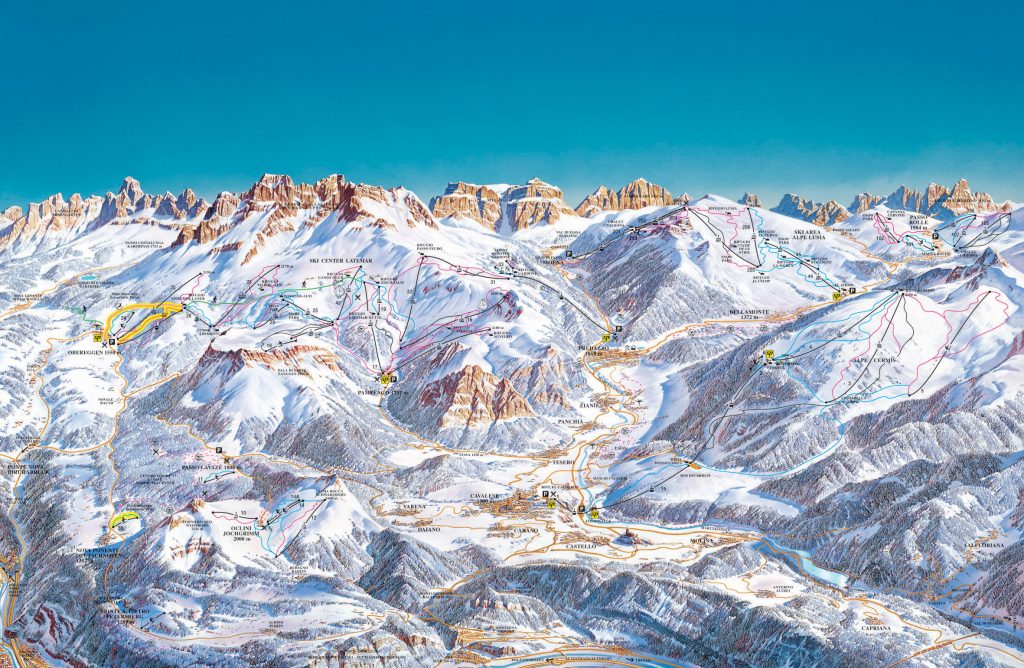
Долина Валь ди Фьемме – ворота Доломитовых Альп. Самая западная часть горнолыжного альянса Доломити Супер Ски. Валь ди Фьемме расположена в административной области Трентино, на высоте 1000 метров над уровнем моря. Длина долины около 25 километров.
В горнолыжном регионе Валь ди Фьемме насчитывается более 100 км отлично подготовленных трасс. Около половины из них – располагается в объединении Латемар.
В Валь ди Фьемме насчитывается с десяток горнолыжных курортов, которые находятся в разных поселках.
Курорты имеют трассы как для новичков так и для опытных лыжников. Самые известные и крупные курорты региона – Кавалезе и Предаццо. Своеобразной визитной карточкой региона является скальная группа Латемар (2846).
Кавалезе – небольшой уютный городок с населением около 3600 человек, расположен на западе Валь Ди Фьемме.
Предаццо – симпатичный поселок городского типа, находится недалеко от Кавалезе ( примерно пол часа езды).
В состав горнолыжной долины также входит и курорт Оберэгген, на высоте 1550 метров над уровнем моря.
Валь ди Фьемме будет ближе к душе в первую очередь начинающим лыжникам. Экспертам здесь будет немного скучновато из-за отсутствия большого количества “черных” спусков. Именно поэтому, долина прекрасно подходит для активного семейного отдыха. Трасс для новичков и маленьких лыжников в Валь ди Фьемме и Оберэггене более чем достаточно.
Благодаря единому ски-пассу Fiemme Obereggen – можно свободно кататься на всех 5-ти горнолыжных районах долины – Альпе Чермис (Alpe Cermis), Латемар (Skicenter Latemar), Альпе Люсия (Alpe Lusia), Пассо Ролле (Passo Rolle) и Оцлини (Oclini).
Либители “целины” найдут для себя много впечатлений в районе Латемар, спустившись по широким снежным склонам.
Для сноубордистов предусмотрен прекрасный 600-метровый сноупарк с большими трамплинами, рэйлами и бордеркроссом. Находится он тоже в Латемаре.
В Валь ди Фьемме существует бесплатное автобусное сообщение между курортами, работает оно с восьми утра до шести вечера.
Горнолыжная долина Валь ди Фьемме входит в альянс Доломити Суперски (Dolomiti Superski) – невероятно красивой зоны катания из 16-ти горнолыжных регионов. Особое преимущество состоит в возможности кататься на всех 1200 км трасс Доломити Супер Ски по единому ски-пассу. А 450 современных подъемников – с ветерком доставят вас на самые лучшие вершины Доломитовых Альп.
трасс
109 км
36 шт., 51 км.
37 шт., 40 км.
0 шт., 0 км.
16 шт., 18 км.
Валь Ди Фьемме
Больцано (BZO), 45 км.
Ора, 25 км.
Отдых на территории курорта:
SPA-центрыРестораны и барыСпортивные возможности региона:
Трассы для беговых лыжПешие прогулкиКатание на саняхСноурафтингБассейнСноубайкСноутюбинг BELLAMONTE
Bellamonte, hamlet of Predazzo, was considered “the mount of hay” of Val di Fiemme. Nowadays it is a renowned resort thanks to both the typical mountain huts at the foot of the mountain chain of Lagorai, and for the breathtaking sunsets that inflame the marvellous mountains Pale di San Martino. One of the right places to visit in Bellamonte is the incredible collection of tools and objects that farmers used to use in the past – the ancient hut hosting Granpa Gustavo’s Museum.
 CAPRIANA
Capriana is the smallest and off-centred village of Val di Fiemme. It includes Maso Bait, Carbonare, Rover, Maso Lio, Maso Casel and Maso Cao de Villa. The first inhabitants of this area lived in Carbonare, whose name derives from the production of “carbone” (coal) from the wood of oak.
Capriana is a privileged destination for all guests looking for nature and quiet life. The village lies near the vineyards of Val di Cembra, the most ancient ones of Trentino, and is surrounded by the Natural Park of Mount Corno. Following the European Trail E5 you arrive at the following places: Prati del Toro, Lago Bianco (1.675 mt.), Lago Nero (1.717 mt.), until the top of Mount Corno (1.815 mt.).
 CARANO
Carano is a typical alpine village situated on a natural terrace dominating the valley and overlooking the mountain chain of Lagorai and Pale di San Martino. This village was built on the remains of an ancient fortified borough, dating back to the Bronze Age. The so-called “Cortazze” or “Corti” characterizes the centre – a large network of passages and tiny streets on the steepest slope to facilitate the flow of water. Wandering around, you can notice wall paintings and frescoes, the beautiful monolithic fountain built in 1888 and the capital dedicated to the Holy Virgin. The church of Carano, dedicated to San Nicolò di Bari, dates back to 1150. Leaving the village, in the direction of Cavalese, on the left wall you can see the stone called «fato lano dela fame» in remembrance of the famine (1570). In Carano you can visit the ethnographic museum Casa Begna and the ancient Ceva source, from which springs a sulfate-calcium-magnesium water, that effectively fights rheumatic and skin diseases. One of the most fantastic walks around the village is Sentiero delle Cascatelle (little waterfalls trail).
 CASTELLO DI FIEMME
Castello di Fiemme is a typical village of ancient construction, situated in a cosy, large and sunny hollow surrounded by meadows and fields. The climate is dry and wholesome: in this place, the lowest quantity of annual precipitations in the whole valley is recorded. The name “Castello” derives from the ancient manor built on the rocky hill of the village. In 1296 the inhabitants of the valley plundered and burned the castle as a symbol of oppression. Nowadays, on top of the hill lies the parish church of S. Giorgio, erected in the Nineteenth century.
In Castello, four medieval buildings known as “Roman houses” are a big attraction. In the tiny streets of the village, there are old country-noble and massive houses, with wooden outdoor staircases and sacred frescoes. In the surroundings, you can visit the Doss Zelòr, headquarters of a prehistoric fortified borough, where they discovered clay vases dating back to the Bronze Age and objects dating back to the second Iron Age.
 CAVALESE
Cavalese lies on sunny shelf in front of the mountain chain of Lagorai. The crenellated bell tower of the church dedicated to San Sebastiano dominates the village. In the old centre, there are arts and crafts ateliers, sportswear shops, a disco, pubs, wine bars, famous restaurants, ancient buildings recently renovated, elegant villas and cutting-edge sport venues. One is the ice stadium, where you can skate both in summer and in winter, and the swimming-pool with indoor and outdoor hydromassage pools. In Cavalese, skiers and hikers can take thecableway to Alpe Cermis, the best place in Lagorai to enjoy marvellous landscapes at high altitude. On board of the cableway you can also reach the bottom of the valley, that in summer is crossed by the cycle lane of the Dolomites — in winter by the cross-country track of Marcialonga.
 DAIANO
The distinctive village of Daiano lies on the road that, from Cavalese, leads to Passo Lavazé. Daiano is one of the tiniest villages of Val di Fiemme, but also the place that can boasts of the most hours of sun throughout the year.
You can recognize the village thanks to the onion-shaped bell tower of the Gothic church dedicated to San Tommaso, built in 1761. On the walls of the most ancient houses there are several sacred frescoes. The buildings show the typical architectural features of the valley, such as monolithic fountains that decorate the streets or the “Roman” house, also called “Castello” (bridge), which is another Gothic and giant building, or the wooden houses and their strict and rustic appearance.
 MASI DI CAVALESE
Among sundials, decorations, gnomes, wooden sheds, lush gardens and breed horses, time stops around the old farms of the tiny Masi di Cavalese. In this little village populated by hard-working people, there are plenty of artisans and even an accordion repairer. This hamlet lies three kilometres far from Cavalese, on the shores of the water stream Avisio. People usually call it “the rainbow village” because, almost after any shower of rain, a rainbow makes its appearance above its houses and fields. Going walking amid ancient houses, agritourisms and haylofts, you can meet several farm animals. Do not forget to have a look at the church dedicated to the Holy Trinity, erected in the Eighteenth century. Masi – which lies near the ski lifts Alpe Cermis, the track of Marcialonga and the Cycle Lane fo the Dolomites – is also a starting point for excursions in nature.
 MOLINA DI FIEMME
Molina di Fiemme lies on the shores of the water stream Avisio, at the entrance of Val Cadino.
Besides Predaia and Stramentizzo, Molina is one of the villages that are part of the municipality of Castello-Molina di Fiemme. The two main hamlets are 2km far from the other.
The building style of the village mirror the liking of the valley. Another peculiarity are the roofs, mostly covered with ceramics scaly boards, produced in the kilns near there. The parish church was erected in 1852 on the highest area of the village and was dedicated to S. Antonio from Padova.
 PAMPEAGO
lpe di Pampeago has already represented the finishing stage of five editions of Giro d’Italia. Ideal destination for bikers, it is the only dolomitic pass to be paved and closed to traffic.
Take the chairlifts to reach the peaks of Latemar, that Unesco declared “World Heritage Site”. In Pampeago, another place is worth a visit: it’s RespirArt, the highest art park of the world, where they organize outdoor concerts at the Theatre of Latemar and land-art excursions. Other walks lead you to the themed park Latemarium in Obereggen or to Malga Pampeago, famous for its lessons to learn how to milk a cow and to prepare butter. The Alpe boasts a favourable position that lets people ski until late April.
 PANCHIÀ
Panchià is a little village of Val di Fiemme, between Tesero and Ziano di Fiemme. Dominated by the massif of Cornon and Mount Agnello, Panchià is a typical mountain village, at a short distance to the ski-areas where you can practice downhill, snowboard and Nordic skiing – as well as the numerous hiking and trekking possibilities that you can enjoy throughout the summer.
 PASSO DI LAVAZÉ
The upland of Passo Lavazé, 8 km far from Varena, is one of the most fascinating landscapes of Val di Fiemme. The huge expanse of meadows, framed by spruces, larches and Swiss pines, is dominated by the mount Pala di Santa (2.488 mt.). From the pass you can stare at a whole panorama over Catinaccio and Latemar, dolomitic peaks that, at every sunset, offer a natural show: the Alpenglow. In summer, this is the ideal place for trekking, walks or mountain bike riding, tasting in mountain huts, fishing and Nordic walking.
 PREDAZZO
In the past there were twelve farms. Now it is the most populated village of Val di Fiemme. Predazzo is known to be the “Geological garden of the Alps” thanks to the highest concentration of geological varieties in the world. In the main and central square, you can visit the Geological Museum of the Dolomites to admire an extraordinary collection of minerals and fossils, but also scientific literature about the formation of the Dolomites. Walking along the geological path of Doss Capèl, between Passo Feudo and Alpe di Pampeago (2.000-2.200 mt. asl.), you can notice sea-beds and beaches, shells and star fish dating back to the era before the appearance of dinosaurs; then lava, ashes and lapilli originated by the ancient volcano of Predazzo.
 STAVA-TESERO
This green and sunny little village, with hotels specialized in welcoming families and in trekking, lets you live completely immersed in nature, halfway to Tesero, Passo Lavazé (the best place for cross country skiers) and Alpe di Pampeago (access to Ski Center Latemar).
Each summer Stava hosts the skyrunning competition Stava Skyrace and, in a well-equipped venue, there is one of the most important indoor climbing walls of Trentino.
TESERO
Tesero is a cradle of traditions in the heart of Val di Fiemme. At Christmas time, one hundred of handcrafted cribs make their appearance from alleys, courtyards, windows, stables and cellars to live up the precious period of “Tesero and its cribs”, which appeals thousands of visitors every year. In the summertime, the inhabitants of Tesero give life to the traditional event called “Le corte de Tiezer” in the courtyards, with fantastic re-enactments of ancient crafts, culinary traditions and music.
 VALFLORIANA
Valfloriana is a village composed of ten hamlets (Barcatta, Casanova, Casatta, Dorà, Montalbiano, Sicina, Valle, Villaggio), perched along the edge of Val di Fiemme. Like Capriana, also Valfloriana is at the boundary with Val di Cembra. Thanks to its off-centred position, there you can enjoy relaxing atmospheres, where traditions are still maintained and continued.
During the day, fans of trekking or snow-shoe walking reach this place to go walking in the wild nature of the mountain chain of Lagorai. At night, the village is the meeting-point of gourmets that come to Valfloriana to taste the delicious and genuine food of local agritourisms.
 VARENA
Varena lies in an excellent position, nestled at the foot of the mount Corno Nero. This village is one of the most ancient centres of Trentino. Walking in Varena you can stare at typical monolithic porphyry fountains. According to the tradition, from the fountains of Varena sprang the best drinkable water of the valley. The church of Varena — consecrated in the Thirteenth century — is dedicated to the saints Pietro and Paolo and the internal Gothic and medieval decorations are worth a visit – the masterpieces were made by Longo and the paintings by Unterperger.
ZIANO DI FIEMME
This fabulous village and its hamlets Zanon, Roda, Bosin, Parti del Cioto and Zanolin, lie along the water stream Avisio, in front of the majestic mountain chain of Lagorai, just at the point where the valley makes a large curve. Fir trees and large green expanses – mostly flat – arrive at the edge of the village.
With its extensive network of hiking and trekking trails in the dolomitic mountain chains of Latemar and Lagorai, Ziano di Fiemme represents the ideal winter and summer resort.
In the summertime, the village is outlined by the Cycle lane of the Dolomites.
 PASSO ROLLE
Passo Rolle, 1980 metres above sea level, connects San Martino di Castrozza with the other valleys in the Dolomites. This mountain pass is home to a small cluster of houses with a few hotels, restaurants, bars and shops at the foot of the magnificent amphitheatre of the Pale di San Martino, the south-western door to the Dolomites, a UNESCO World Heritage Site. The area, dominated by the unmistakable outline of Cimon della Pala (3.186 m), is an excellent starting point to set off on walks, hikes and mountain bike outings.